.png)
Tools developed by the ESMLab
The ESMLab is involved in the construction and application of mathematical and computer models of energy systems using mathematical programming, system dynamics and hybrid models combining these methods. Selected tools are briefly described below and more thoroughly in the referenced papers. Developed tools are used for energy system analysis and forecasting in order to formulate energy policy recommendations at different territorial levels and time perspectives.
TIMES is an economic model generator for energy systems. It belongs to a class of bottom-up models providing a technology-rich basis for analysing energy system development over a long-term period. Its objective function represents the total costs of the supply of energy services, which are minimized by the model. The detailed description of decision variables and equations of TIMES can be found in (Loulou, 2008). TIMES-PL is the name of the model of the Polish power system generated with the use of TIMES. TIMES-PL includes all existing thermal power plants as well as combined heat and power plants (Gawlik L., Wyrwa A. et al., 2013). These are mainly hard and brown coal-fired plants.
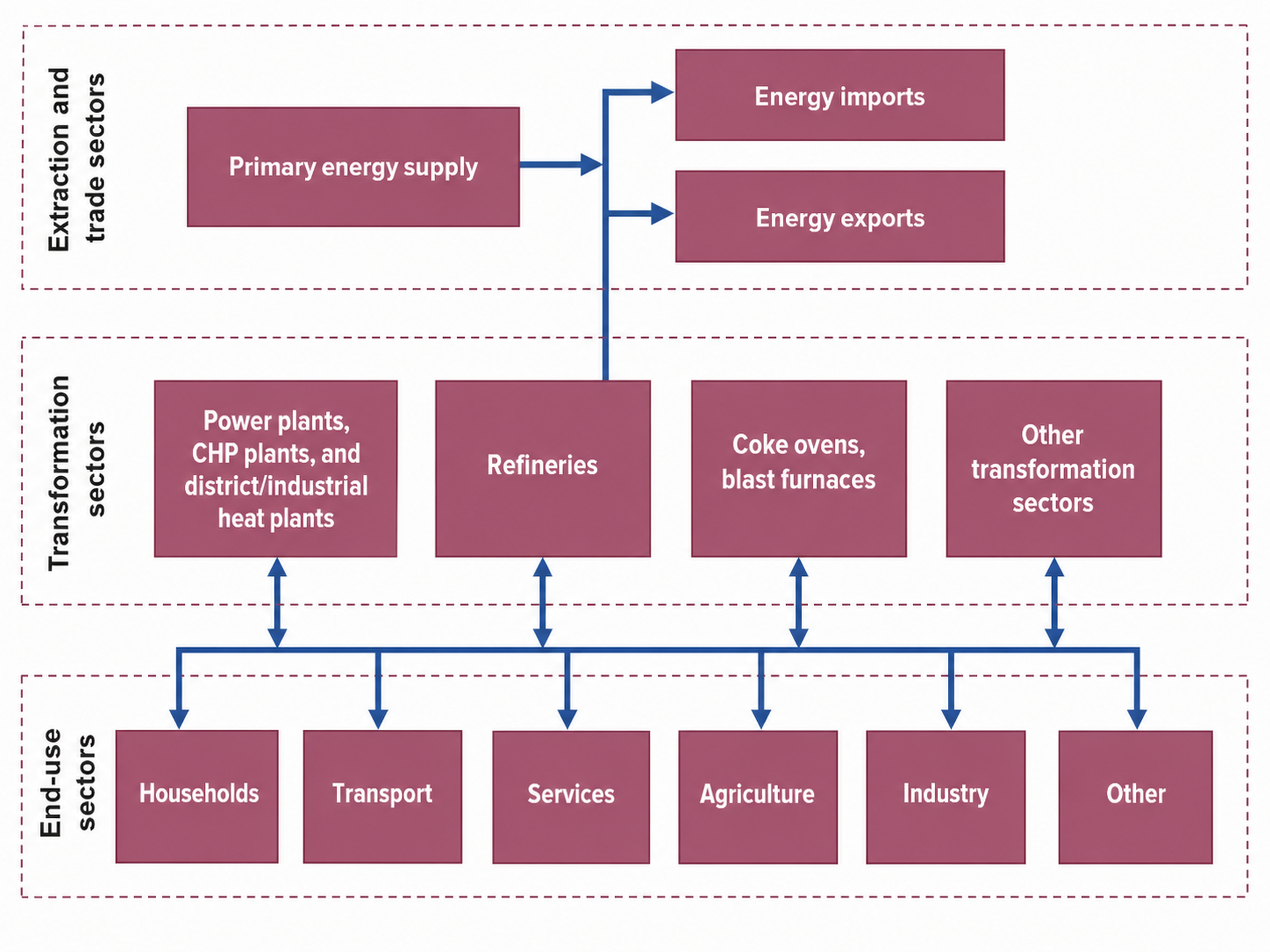
Additionally, existing plants which make use of renewable energy sources (RES), such as onshore wind, photovoltaic and hydro power plants, are taken into consideration. The model can also make decisions to invest in new energy technologies, such as nuclear power, renewable energy sources and other generation technologies. All technologies included in the model are characterized by a set of technological and economic parameters. The model was run for the period from 2010 to 2050 with a five-year temporal resolution and provided results for the central, so-called milestone year. Each milestone year was further split into 224 time slices in order to better reflect the temporal characteristics of energy demand and supply (Wyrwa A. et al., 2015). A new approach for coupling short- and long-term planning models to design a pathway to carbon neutrality in a coal-based power system was proposed by Wyrwa A. et al. (2022).
DOI: 10.3390/en16165918 | BADAP
DOI: 10.1016/j.energy.2021.122438 | BADAP
DOI: 10.1016/j.energy.2015.05.066
Available online
Available online
DOI: 10.3390/en14133744
Model of Economic Dispatch and Unit Commitment for System Analysis (MEDUSA) was developed at AGH University of Science and Technology in Poland. The MEDUSA code has been written in the GAMS programming language. As indicated by its name, it solves a mixed integer programming (MIP) problem related to unit commitment (UC) and economic dispatch (ED) in electrical power production. The optimization is performed with the use of the CPLEX solver. MEDUSA optimizes the operation of the power system using hourly temporal resolution.
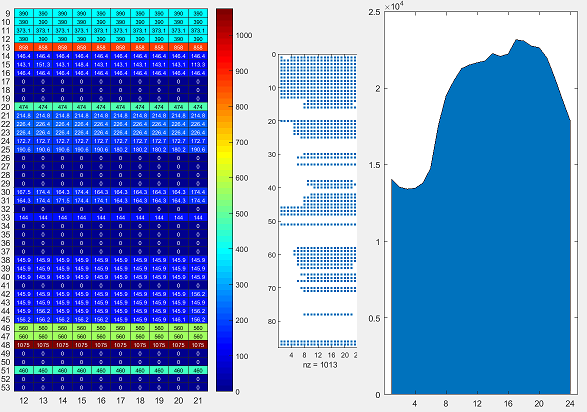
MEDUSA minimizes the total costs of balancing the forecasted load by making decisions on whether a dispatchable unit i is in operation at time t and determining its power output, while taking into account generation from non-dispatchable units. The objective function represents the total costs of balancing the forecasted load, including start-up, shut-down and operation costs, costs of load shifting through demand-side response, as well as costs of load shedding.
DOI: 10.3390/en13081952 | BADAP
DOI: 10.1016/j.energy.2021.122438 | BADAP
πESA is a platform designed for optimization of Poland's power sector considering air pollution and health effects. It belongs to the category of integrated assessment modelling tools and has been developed to support energy and environmental policy development in Poland. πESA places a strong emphasis on computation of a least-cost pathway for power system development while assessing state indicators (e.g. pollutant concentration) and impact indicators (e.g. impacts resulting from population exposure to PM2.5 pollution) in a simulation mode. Its concept is based on the Drivers-Pressures-State-Impact-Response (DPSIR) framework. Based on the chain of causality, πESA links human-caused drivers (use of primary energy sources) to pressures on the environment (emissions), changes in environmental states (air quality and human health) and eventually responses aimed at correcting the situation (constraints imposed on energy scenarios).
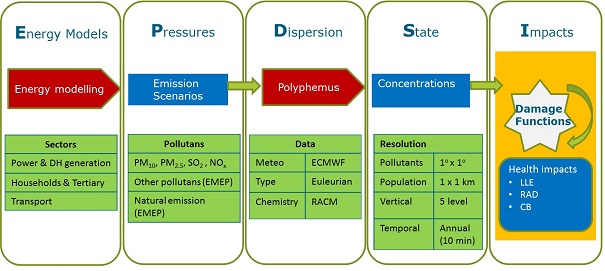
Drivers, Pressures and Responses are addressed with the use of the
energy-economic model TIMES-PL.
States, including ambient air concentrations and deposition of pollutants,
are covered by Polyphemus, a full system for air quality modelling.
A Module for Assessment of Environmental and Health Impacts (MAEH)
is used to estimate the Loss of Life Expectancy (LLE) indicator.
LLE relates population exposure to PM2.5 concentrations with the
number of years of life lost per person for a given population cohort,
which was found suitable for comparative analysis of energy scenarios.
Registering to PIESA
DOI: 10.3390/en14248263 | BADAP
DOI: 10.3390/atmos11111222 | BADAP
DOI: 10.1016/j.envsoft.2015.04.017
DOI: 10.1007/978-3-030-60914-6_15
TIMES-HEAT-EU has been developed by the ESMLab team within the REFLEX project to assess transition pathways towards more sustainable district heat supply and to analyze the role of district heating systems in enhancing energy system flexibility. TIMES-HEAT-EU is a bottom-up, linear optimization model built with the use of the TIMES generator (Loulou, 2008). It belongs to the class of integrated capacity expansion and dispatch planning models. The objective function represents the total profits of all actors on the centralized district heating market. Supply technologies incorporated into the model consist of: (i) Combined Heat and Power Plants (CHP), (ii) Heat Only Plants (HOP), (iii) Power-to-Heat Plants (P2H), and (iv) Thermal Energy Storages (TES). The geographical coverage of the model extends over EU Member States. Each country considers its own district heating systems with no trade between countries. The modelling time horizon covers the period from 2015 to 2050 with five-year time steps. Each modelling year is further divided into 224 time slices derived by aggregating data every three hours in seven days for four seasons (8 x 7 x 4). Annual district heat demand, which is an exogenous parameter in TIMES-HEAT-EU derived from the FORECAST model, is split into three categories depending on the end-use sector to which it is supplied: residential, tertiary and industry. In the case of residential and tertiary sectors, annual demand is split into individual time slices mainly by taking into account variations in outdoor temperature. For industry, it is distributed more evenly.
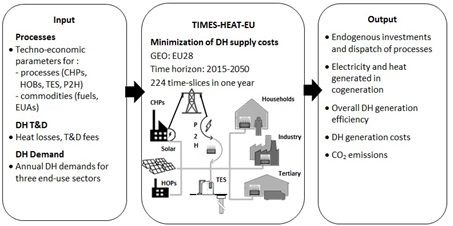
TIMES-HEAT-EU takes into account major EU policies related to district heating, including requirements determining high-efficiency cogeneration. More detailed operational constraints, such as allowable power-to-heat ratios or ramp rates, are also defined. The EU Emissions Trading System (ETS) is modelled implicitly with the help of prices for CO2 emission allowances and emission factors for individual fuels.
DOI: 10.3390/en15093165 | BADAP
DOI: 10.1007/978-3-030-60914-6_12
DOI: 10.1109/EEM.2017.7981983
Available online